The Religion Based on Japanese Traditions Such as Martial Arts and Meditation Mixed With Buddhism
(RNS) — In all Zen traditions, meditation is the backbone of the practice. Students sit with a alpine spine, hands loosely interlocked and eyes half-closed. At Chosei Zen in Madison, Wisconsin, though, new students are never quite prepared for the rigor of Rinzai Zen, which asks participants to remain motionless for up to 45 minutes — twice a day.
"It was so challenging, exhausting and painful," said Kristi Crymes, 47, a family unit doctor in Springfield, Missouri, who attended an intensive retreat at the dojo in October 2017.
"And still, it was the physical part of information technology that made me see — this is what my mindfulness do has been missing all along," Crymes said.
Rinzai's embodied, physically intense form of spiritual training goes counter to what many people expect from Zen do. "It'due south not mystical. Information technology'due south manual labor," said the abbot of Chosei Zen, Gordon Hakuun Greene Roshi. "We're trying to soak this stuff into our bones. If I want to be effective in the globe, if I want to bring pity, if I desire to accept care of people, I've got to get this into my bones so that it'due south available at all times and nether all circumstances."
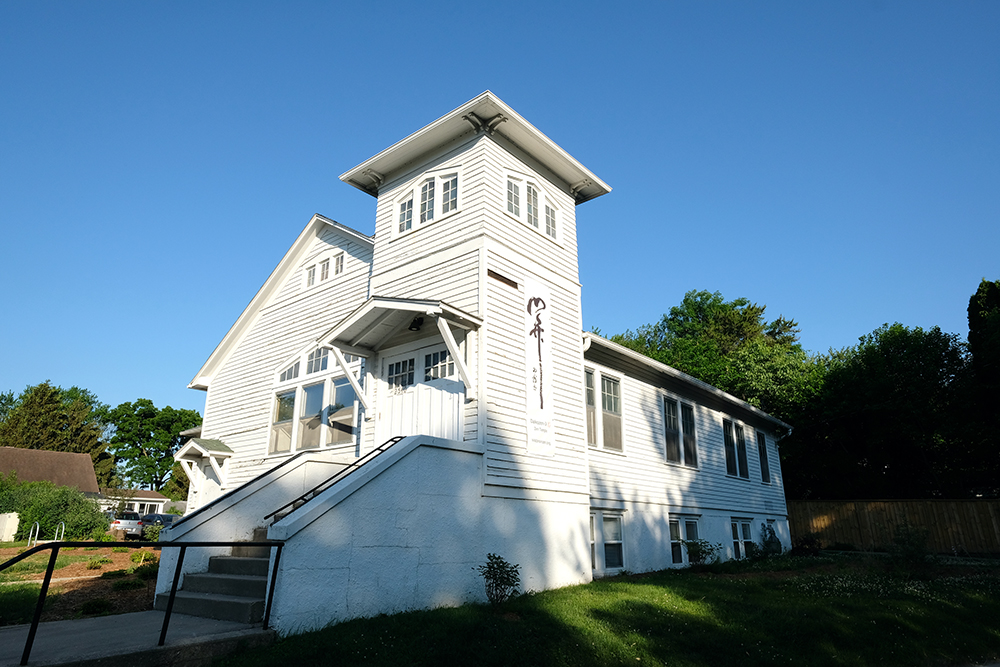
Chosei Zen dojo in Madison, Wisconsin. Photo courtesy of Anita Taylor/Chosei Zen
Abbot Emeritus Kenneth Setsuzan Kushner Roshi calls Rinzai'south all-in approach "the highest form of spiritual training in Zen." In Japanese, the word for its rigor is "shugyo," sometimes translated by teachers as "deep spiritual forging" — equally in fashioning metallic.
"When people showtime start sitting, they really struggle," said Ginny Jiko Whitelaw Roshi. ("Roshi," appended to a person'south proper noun, identifies them as a Zen master.)
But the ability of the stillness informs practitioners' habits, on and off the cushion. "It's putting a clutch between impulse and activity," said Whitelaw. "The thought can arrive, just it doesn't become acted upon. The student gains the freedom to act with intention, "rather than just a knee-jerk response to any impulse is arising."
Also in play are posture and breath — the Japanese call it "hara," loosely translated as abdominal breathing. "There is no Zen without hara," the saying goes in this tradition, as the technique is considered a necessary tool for the cultivation of "samadhi," a state of relaxed concentration that helps to generate "ki" or life strength.
What gives this lineage its signature stamp from others in the Rinzai tradition is the integration of the martial arts and the fine arts — self-defence force skills, archery and Japanese bamboo flute. Martial arts build up ki, while preparation in the fine arts refines it and meditation grounds it.
Kushner, Greene and Whitelaw, all Zen masters, were students of Japanese American Tenshin Tanouye Rotaishi, an accomplished martial artist and calligrapher who co-founded the lineage — a line of Buddhist teachers who pass downward a given practice — with his teacher Omori Sogen Rotaishi.
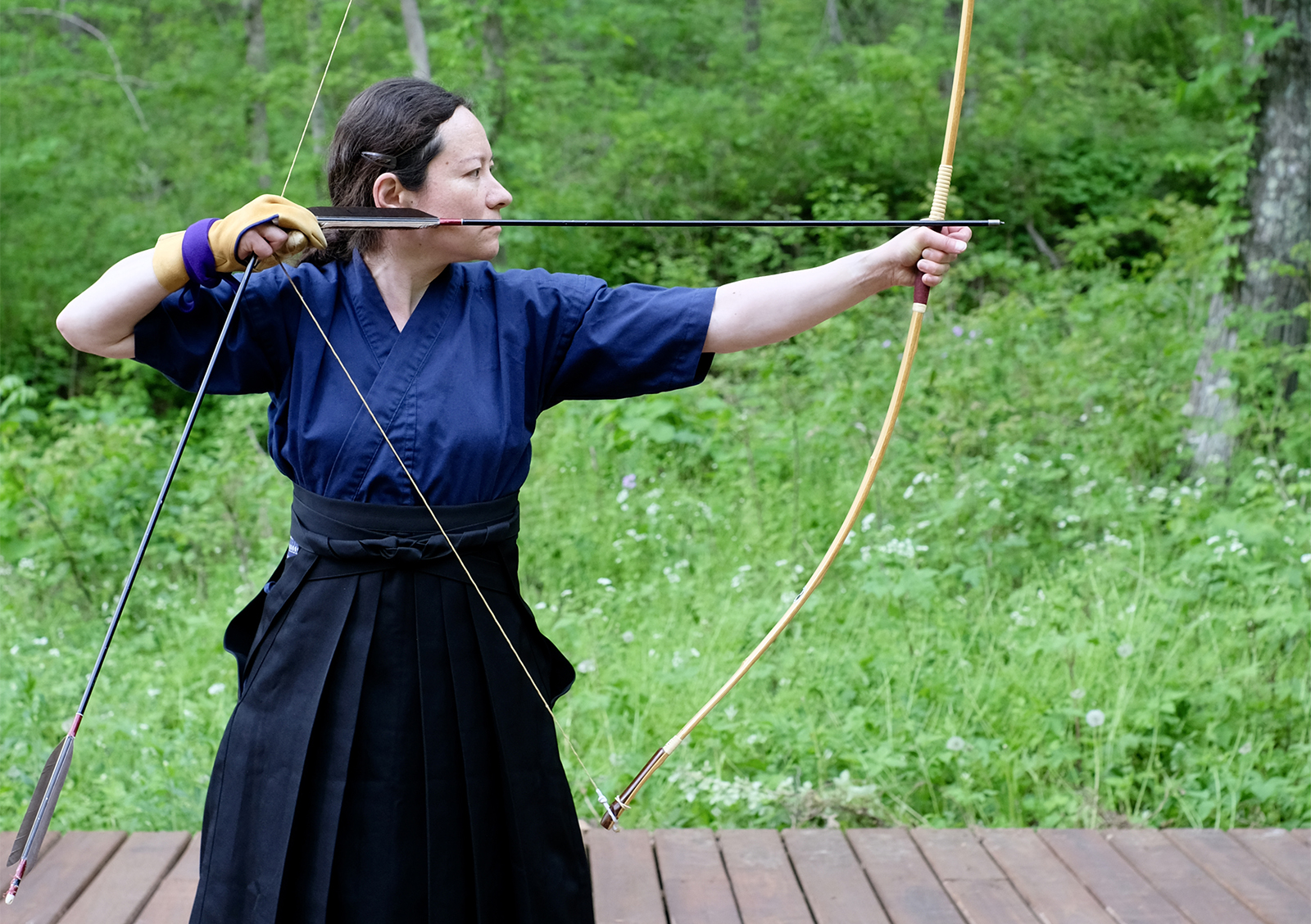
Anita Taylor practices archery at Chosei Zen dojo in Madison, Wisconsin. Photo courtesy of Anita Taylor/Chosei Zen
In 1972 Tanouye and Omori established Chozen-ji in Honolulu. It was the kickoff Daihonzan temple of Rinzai Zen outside of Japan, and Kushner explained that its course of Zen training was aimed to help bring Zen to the W. Kushner and Greene every bit well as some other instructor based in Hawaii, Wayne Kyoen Honda Roshi, are among Tanouye Roshi's successors.
Kushner founded the Madison dojo in 1982. Greene followed in 2005 and oversaw the building of a Zen grooming center on 108 rural acres in neighboring Leap Dark-green. Two years ago the group bought a decommissioned church in downtown Madison and now the group is in the process of converting information technology into a third dojo. A virtual dojo was added during the pandemic.
In the 1980s, Whitelaw was working at NASA, following her dream of condign an astronaut, practicing aikido, a Japanese class of cocky-defence force, and sitting zazen as part of her plan. While she failed to make the cut to go to space, she rose through the ranks of NASA, becoming a deputy manager working on the international infinite station.
Just after her union ended and a close friend died, Whitelaw made the decision to devote herself full time to Zen preparation. "It went from beingness something to brand my life better to a deep inquiry nigh what the heck was my life about and how could I be of service through this instrument."
In 1996 she became a Zen priest and today she is founder and CEO of the Found for Zen Leadership, a sister organization to Chosei Zen.
The lineage'due south physical demands ofttimes attract able-bodied spirits, such as the Madison dojo head priest, Scott Kou-un Kiel Roshi.
"I was doing meditation independently and then grooming in martial arts at another dojo" and plant Chosei Zen while searching for a place that combined the ii, he said. "A lot of aikido is more aikijutsu. They're teaching you the techniques, just they're non educational activity you how this relates to being a 18-carat man being."
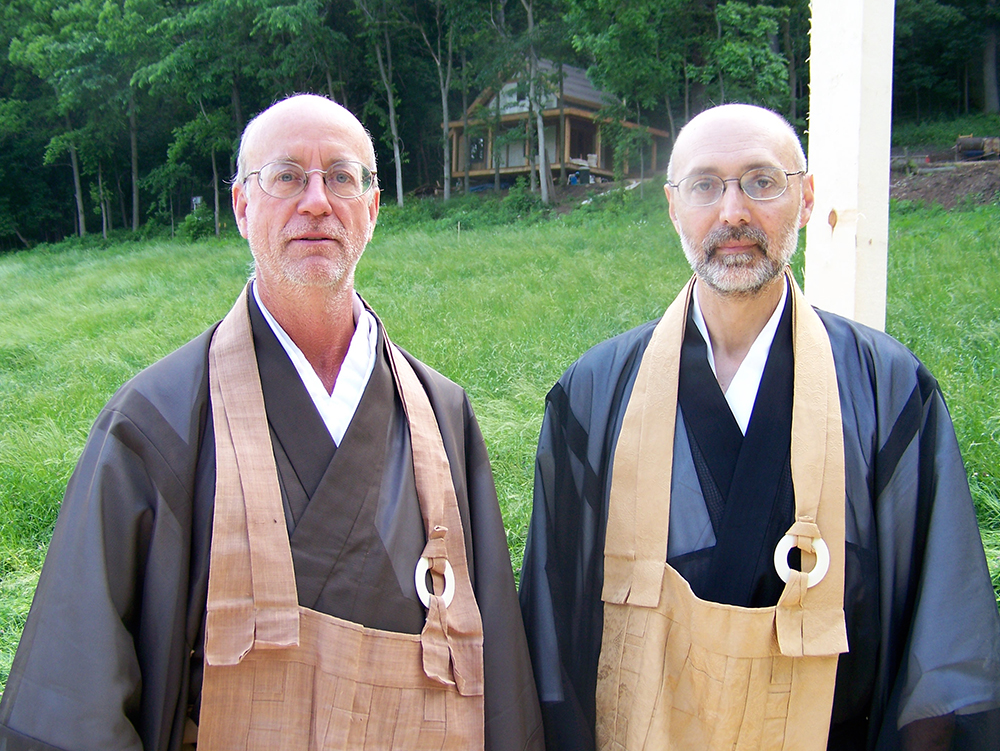
Abbot of Chosei Zen Gordon Hakuun Greene Roshi, left, and Abbot Emeritus Kenneth Setsuzan Kushner Roshi. Photo courtesy of Anita Taylor/Chosei Zen
What keeps many students engaged, nonetheless, are this tradition's other challenges, such equally the steep learning curve of the Japanese bamboo flute, or shakuhachi. Sustaining a single notation can take months to principal. "It wasn't until recently I was able to play the high register more hands," said student Dave Stahlberg. "It'southward the idea of keeping at information technology, even afterward neglect, neglect, fail, neglect, quantum, fail, fail, fail, fail, fail, breakthrough. I enjoy that. I don't know why."
Kate Watters outset heard shakuhachi during a three-day online intensive. "It was like this guide, bringing me through this difficult thing with such beauty," she said. "And so here I am. It's very frustrating, but I recall that sound and remember maybe, just maybe, i 24-hour interval."
While technique is important and frustration a given, Rinzai Zen is meant to prompt a deeper query of the self. "Who are you?" asked Honda, who teaches shakuhachi at Chozen-ji in Hawaii. "I of the ways in Zen is to cultivate doubt. The greater the doubt, the amend. And that doubt has to practice with, 'Who am I?'"
Later on Kristi Crymes left the Chosei Zen retreat three years ago, she said, "people responded to me differently and I was responding to my environs differently." Unremarkably shy, she said the training has fabricated her more outgoing and present in her work.
More importantly, it has transformed her work equally a dr. — rearranging the human relationship between idea and action. "The only way to practise medicine responsibly and meaningfully is through this lens," she said. "It keeps me existence who I want to exist."
Source: https://religionnews.com/2021/06/08/all-in-buddhist-practice-combines-meditation-and-martial-arts/
0 Response to "The Religion Based on Japanese Traditions Such as Martial Arts and Meditation Mixed With Buddhism"
Post a Comment